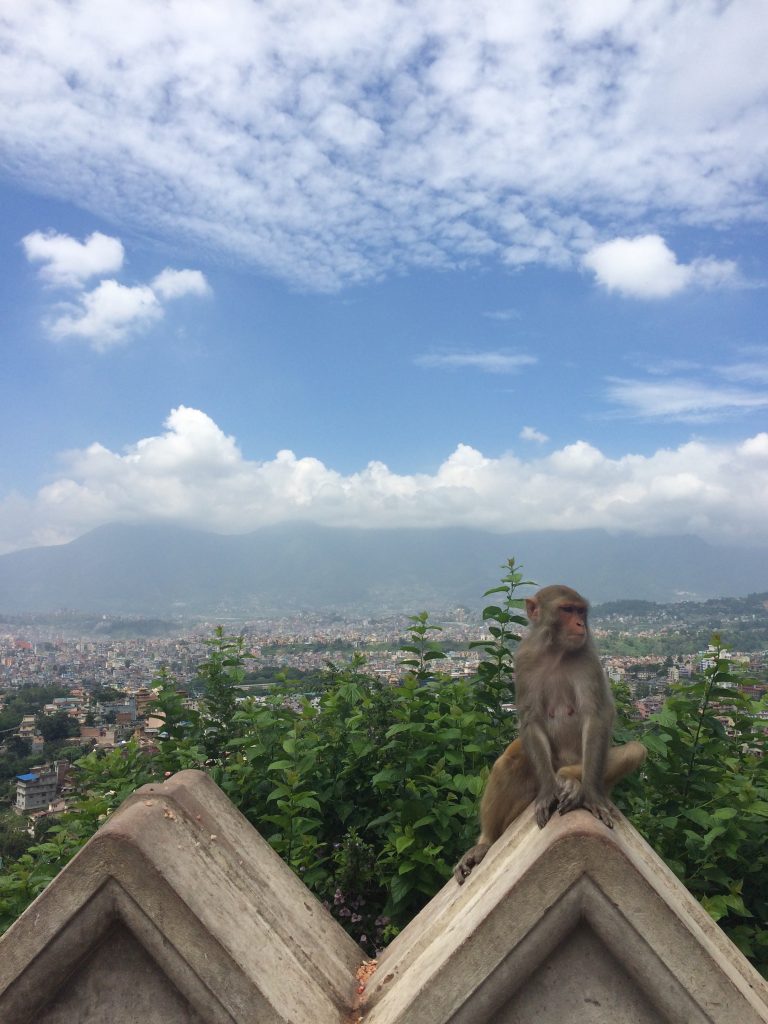
Silly monkey, you’re looking the wrong way!
Did you know…
- Kathmandu has the densest UNESCO listed World Heritage Sites among world capitals. Within a 10-mile radius, you can visit Pashupatinath, the Swayambhunath, Boudha Stupa, Kathmandu, Bhaktapur, and Patan Durbar square.
- The national flag of Nepal shirks the more commonplace quadrangular shape. It’s pair of triangle-ish-things are said to comprise the world’s most mathematical flag…It’s hard for us to describe the shape, so we recommend you Google it!
- The Kathmandu Ghukas were never conquered, so the Nepali people have never been ruled by foreigners. Cool, huh?
We learned all of this (and more!) with the help of our Nepali guide, Prakash, as we explored the more historic sites of Kathmandu for the day. A solid first group audition for the Amazing Race, we enjoyed wandering from place to place, soaking in the unique feelings and culture associated with each location, appreciating the different faces of modern Kathmandu. It also helped that there were monkeys. They’re just so darn cute!
Don’t believe us? Check out this video:
The Swayambhunath (which translates as “Sublime trees”) temple is a sacred Buddhist temple atop a high peak within the city limits. Beyond sweeping views of the sprawling valley and photo shoots with primates, we learned that this temple was built over 2,000 years ago when Kathmandu Valley was nothing more than a giant lake. It was fun to negotiate with shopkeepers and admire their handicrafts. While we love the sleepy, all-seeing Buddha eyes that stare out from the top of these temples, we were ready to explore Nepal’s Hindu side, too. In fact, more Nepali people identify as Hindu (around 80%) than as Buddhist ( around 10%).
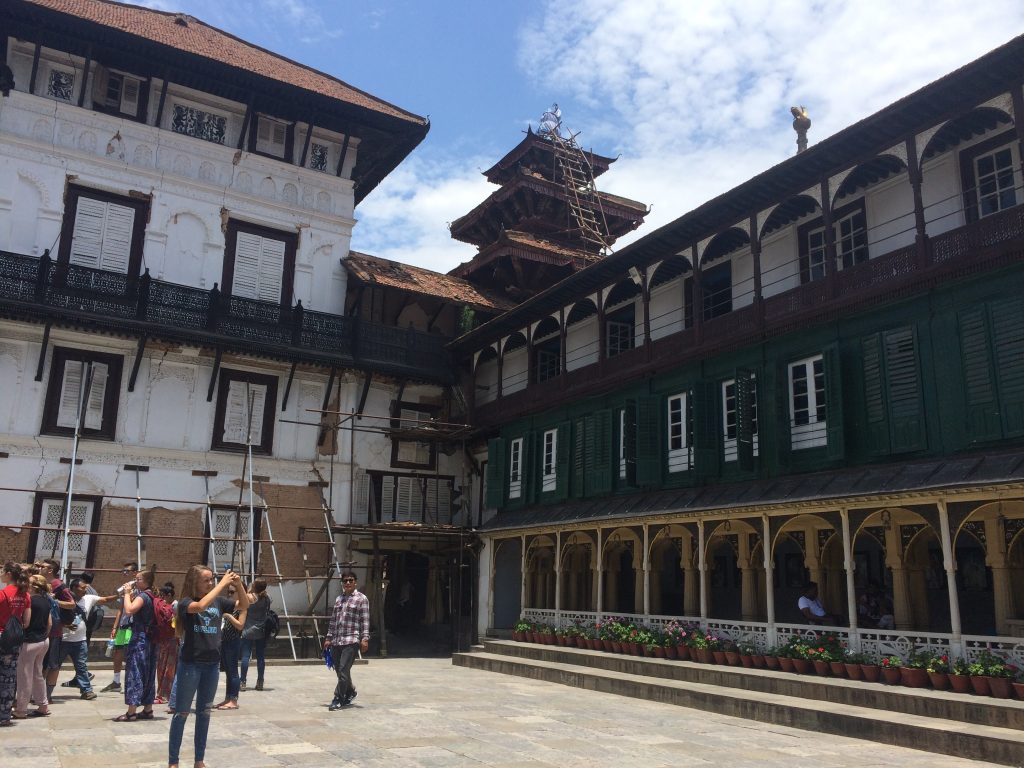
Durbar Square is known as the most important place to visit when in Kathmandu.
Despite the evident crumbles from the earthquake of 2015, it wasn’t difficult to imagine the Durbar, or palace, square in it’s heyday (though now its grandeur is more understated). The Hindu temples look like pagodas reminiscent of Japan, but are distinctly Nepali thanks to their brick and wood materials. Since the monarchy was abolished in 2008, Durbar square isn’t used for coronation ceremonies or vast gatherings of the people. It’s now a museum, a beautiful site that tips its hat toward yesteryear, and a worthwhile project in need of ongoing restoration.
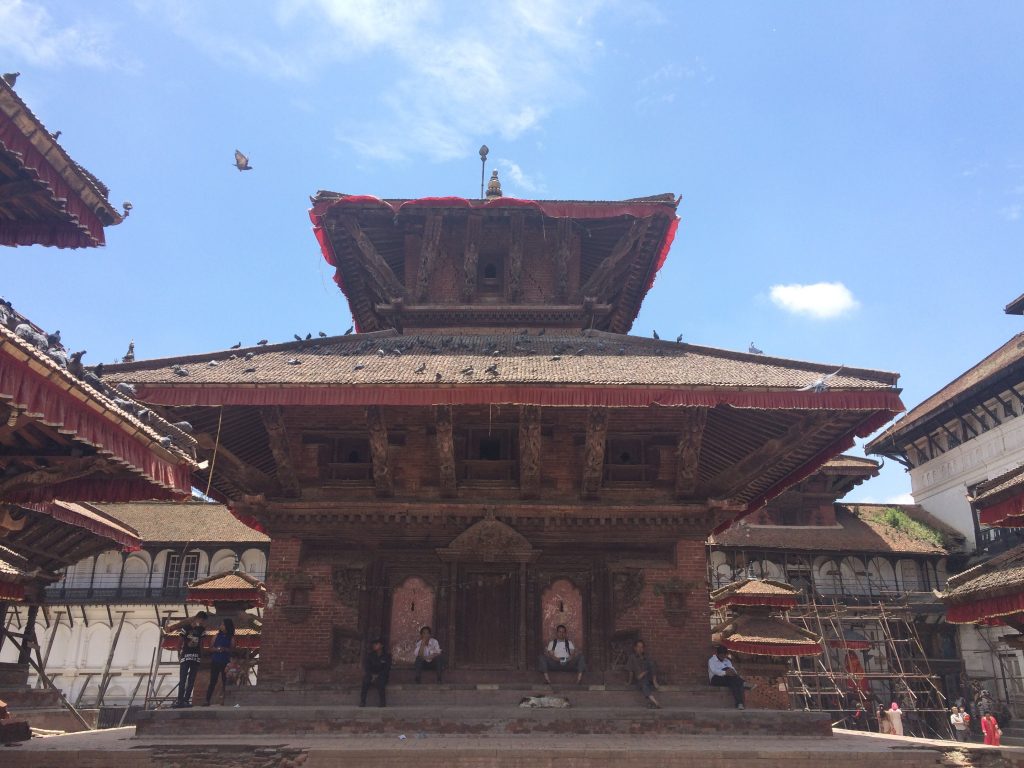
Before the Unification of Nepal, Nepal consisted of small kingdoms, and Durbar Squares are most prominent remnants of those old kingdoms in Nepal.
By this point it was high noon, and we were all ready for some shade. We dined at a local restaurant that is primarily staffed by deaf and mute Nepali citizens. The differently abled have a tougher life than most of us, and there are not many jobs that fit their skills, so it was awesome to support the cause and learn a little more about social services like these in Nepal. Plus, the thali sampler was *just* the right fuel for our afternoon wanderings around Thamel. A popular area for visitors to Kathmandu, Thamel resembles a labyrinth of shops and services and tiny alleys and gulleys and lanes. Topping off the afternoon with ice cream was the perfect treat.
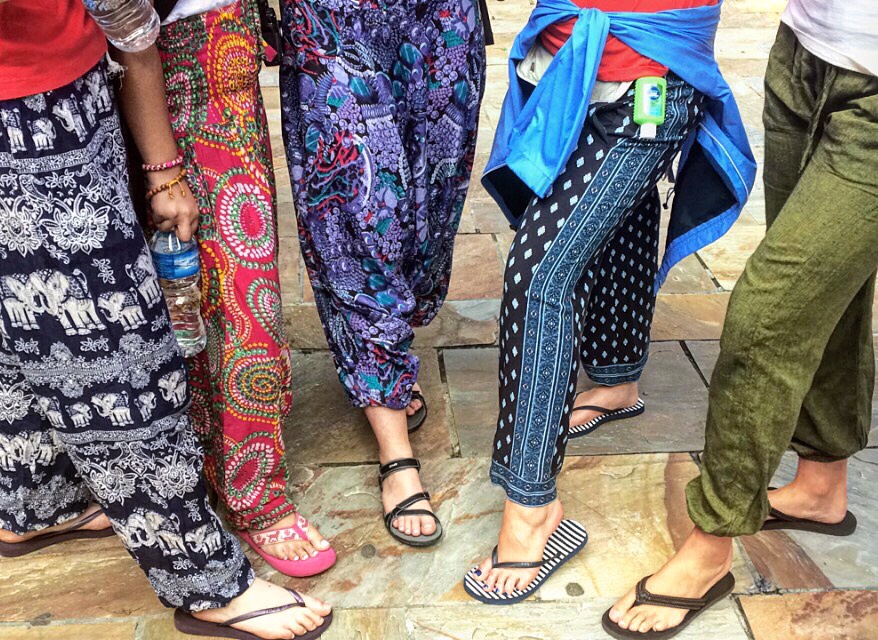
Some of the group rockin’ the latest in travel fashion.
And so we spent our last night in Kathmandu, at least for now, watching the rain clouds part above the mountains and making way for pinks and oranges to cast their colors on our neighborhood stupa. That view was darn right spectacular. Here’s to starting our projects tomorrow!
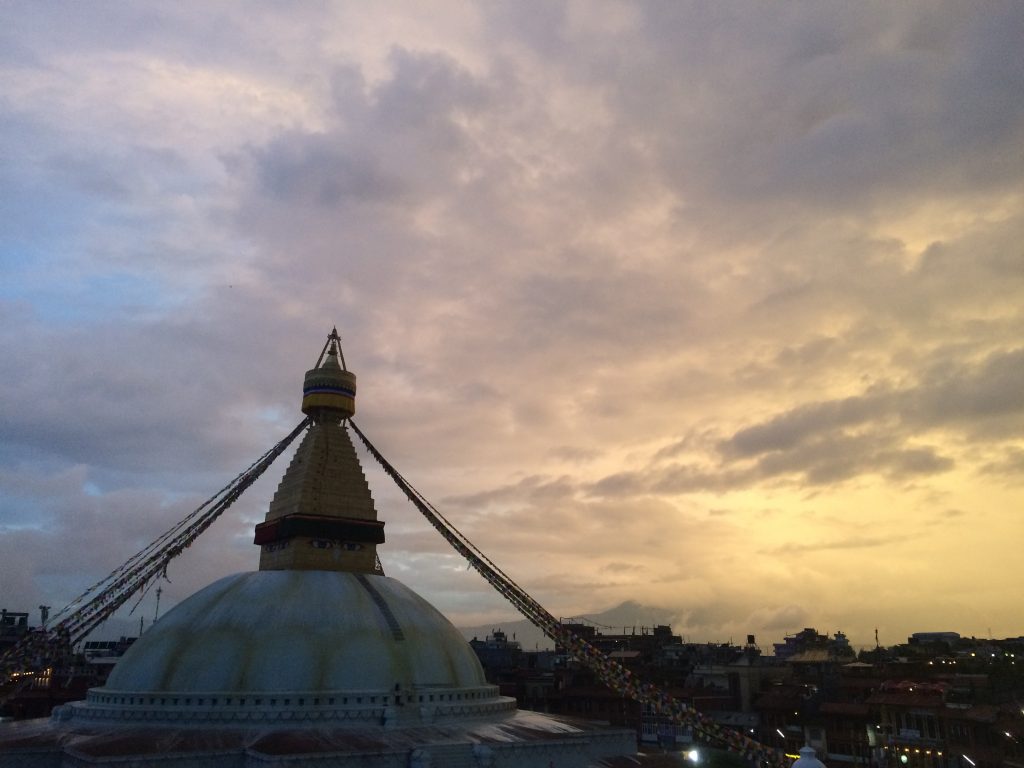
These sunsets make us swoooooon!
Namaste in a big way,
Megan & Ady